The 2026 KOSPI Crash: How Samsung and SK Hynix Exposed South Korea’s Fragile AI-Driven Economy
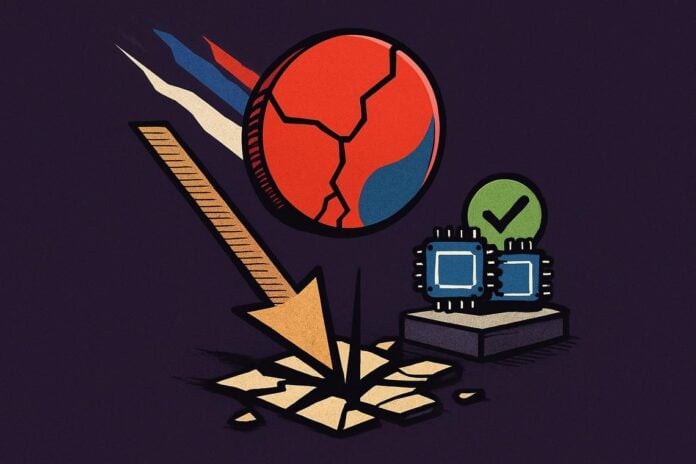
In late 2026, South Korea’s KOSPI index plummeted by 33%, revealing a dangerous truth: the nation’s economic future was teetering on its own success. The crash wasn’t just about numbers—it was a warning to the world about the risks of betting everything on AI and a few corporate giants.
The 33% KOSPI Plunge: How Overreliance on Samsung and SK Hynix Created a Perfect Storm
Picture this: A casino where all the chips are tied to one table. That’s what South Korea’s KOSPI looked like in late 2026—a market so overexposed to just two companies that a single misstep felt like a house of cards collapsing.
The crash wasn’t sudden; it was a slow burn. By July 2026, foreign investors had pulled out $13 billion from Korean stocks in one month alone, adding up to a staggering $81 billion since January. It’s like a dam bursting after months of pressure: AI hype, overvalued chips, and geopolitical jitters finally gave way. The KOSPI plunged 33% in weeks, wiping out $2 trillion in market value.
But here’s the twist: While everyone else was fleeing, Samsung and SK Hynix stayed oddly popular. Global funds kept buying their shares, even as SK Hynix reported weak earnings. Why? Because these two companies make up over half of the KOSPI. It’s like betting your entire portfolio on a single horse race—and then watching it stumble.
Retail traders turned the chaos into a nightmare. Leveraged ETFs and margin financing—think borrowing money to bet bigger—amplified losses. One investor even took out a loan using their apartment as collateral. When prices fell, forced liquidations triggered a domino effect. It wasn’t just bad luck; it was a systemic flaw.
And don’t forget China. While Samsung and SK Hynix were busy dominating AI memory chips, Beijing’s $295 billion AI push cast a long shadow over Seoul’s semiconductor crown.
So, what’s next? The KOSPI’s crash wasn’t just about AI—it was a perfect storm of overreliance, leverage, and global competition. And the question haunting investors? How do you rebuild a market when the entire deck is stacked against you?
Semiconductor Giants: Why Samsung and SK Hynix Survived the Crash
The KOSPI crash of 2026 felt like a Hollywood blockbuster—dramatic, fast-paced, and full of twists. While the index tumbled 33%, Samsung and SK Hynix stood strong, their shares absorbing blows but not breaking.
Global investors saw something in these two giants. Sure, their stocks dropped 21% and 35% in July 2026, but by early 2025, they had already climbed 4x and 10x. It’s like watching a stock market version of Inception—even as the ground shook, long-term bets on AI infrastructure kept pulling people back in.
Chinese competition looms, but Seoul still holds an edge. The world needs cutting-edge memory chips to power the AI revolution—and no one makes them better than Samsung and SK Hynix.
Retail investors, however, were left with a wake of destruction. Leveraged ETFs turned the KOSPI into a casino, and when the music stopped, panic set in. But for global funds, it was an opportunity to buy the future. After all, who else is making the chips that will fuel the next decade of AI?
The crash was a wake-up call for South Korea—but for Samsung and SK Hynix, it was just another chapter.
Retail Investors and the Leveraged ETFs That Broke the Market
In 2026, retail investors in Seoul poured 78 trillion won ($54.2B) into leveraged ETFs, betting on a tech-fueled AI boom. But when the KOSPI crashed, it felt like a roulette wheel turning against them.
These ETFs were supposed to democratize investing—but instead, they became a double-edged sword. Retail traders could bet on individual stocks with borrowed money, amplifying gains… and losses. When Samsung and SK Hynix faltered, the leverage turned a bad day into a disaster.
Margin calls worsened the chaos. Investors who’d borrowed to buy shares faced forced liquidations, sending prices spiraling further. One trader, Lee Jung-min, lost his entire investment after using his apartment as collateral. “The government turned the stock market into a casino,” he said.
Kim Han-kyung, a 30-something Seoul resident, vowed never to invest again. “I got swept up in the frenzy,” she said. “Now I’m scared.” Her story wasn’t unique—many retail investors were lured by AI hype and concentrated bets on a few stocks. When the bubble burst, their losses weren’t just financial—they were existential.
The crash exposed a deeper truth: South Korea’s economy relies too heavily on chaebols like Samsung and SK Hynix. When they stumble, the whole market follows.
Geopolitical Risks: How U.S.-China Tensions and Chinese AI Threaten South Korea
South Korea’s KOSPI crash wasn’t just a stock market tantrum—it was a geopolitical earthquake. At its heart: U.S.-China tensions and Beijing’s $295 billion AI push.
South Korea’s semiconductor giants, Samsung and SK Hynix, are caught in the crossfire. U.S. export controls on their Chinese plants add layers of risk—and opportunity for China to build its own AI infrastructure.
The crash reignited fears of South Korea’s economic fragility. Investors still price Korean stocks at a “Korea Discount,” wary of opaque ownership structures and corporate governance issues.
As the dust settles, one thing is clear: The KOSPI crash wasn’t just about AI or chips—it was a warning shot for a nation betting its future on a global tech race it might not win alone. Can South Korea rebuild trust in its system? That’s the real question.
The Korea Discount: Why Chaebol Governance Still Haunts South Korea’s Markets
South Korea’s 2026 crash wasn’t just about AI—it was a wake-up call for weak corporate governance and economic overreliance. Semiconductors account for 43.8% of South Korea’s exports, but this reliance feels like betting everything on one hand.
Samsung and SK Hynix are both lifelines and liabilities. Their dominance means the market’s fate hinges on a few companies—like a house of cards leaning on one pillar.
Chaebols, with their family-run structures and weak governance, have long been criticized for lacking accountability. When SK Hynix reported weak earnings, it felt like a structural crack. Investors slapped a “Korea Discount” on shares, treating them as riskier than global peers.
The crash exposed South Korea’s fragility. With 30–40% of SK Hynix’s chips made in China, geopolitical tensions and U.S. export controls added layers of risk.
Reforms are needed, but change is slow. Until then, the KOSPI will keep dancing on a tightrope—until the next fall.
Lessons for the Global AI Bubble: Could South Korea’s Crash Be a Warning Sign?
South Korea’s 2026 crash was a wake-up call for the global tech world. The KOSPI’s collapse revealed how reliant Asia is on a few giants—and how vulnerable that reliance makes it to geopolitical and market risks.
Tech-heavy markets from Tokyo to Taipei are now staring at the same mirror. If South Korea’s AI bubble pops, the ripple effects could shatter other economies. It’s like Jenga: one wrong move, and the whole tower crumbles.
But here’s the kicker: Even as investors fled, some still bet on the long game. Global funds kept buying Samsung and SK Hynix, seeing them as anchors in a stormy sea. Yet with Chinese rivals ramping up production, the question lingers—can these Korean titans keep their edge?
The crash is a warning for the global AI bubble: Overreliance on a few companies can be dangerous. The world needs to balance innovation with caution.
Conclusion
South Korea’s 2026 crash was a stark reminder: No economy is immune to the fragility of overreliance on a few giants or the whims of global AI trends.
What’s your bet on the next AI-driven bubble? Will you be on the winning or losing side?